
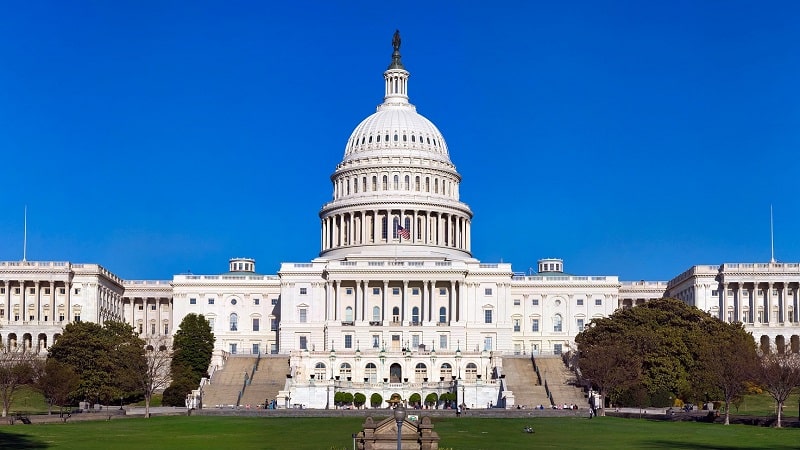
The House Appropriations Committee on Monday released its final four spending bills as lawmakers race to meet a Jan. 30 funding deadline and avoid a lapse in government funding.
The measures would fund the departments of Homeland Security (DHS), Defense, Transportation, Housing and Urban Development (HUD), Health and Human Services (HHS), Labor, Education, and related agencies.
With the House scheduled to recess next week, leaders must advance the bills through the chamber this week.
Funding for Immigration and Customs Enforcement (ICE) could complicate passage of the DHS measure, as divisions persist among both parties over the agency’s role and oversight.
Rep. Rosa DeLauro, D-Conn., the top Democrat on the Appropriations Committee, acknowledged that the bill “does not include broader reforms Democrats proposed” regarding ICE but cautioned Democratic lawmakers against opposing the bill and risking broader disruptions.
“I understand that many of my Democratic colleagues may be dissatisfied with any bill that funds ICE,” DeLauro said. “The Homeland Security funding bill is more than just ICE. If we allow a lapse in funding, TSA agents will be forced to work without pay, FEMA assistance could be delayed, and the U.S. Coast Guard will be adversely affected.”
Lawmakers are seeking to complete all 12 annual appropriations bills for fiscal year 2026. Six have already cleared both chambers.
Congress has roughly two weeks to pass the remaining bills covering Financial Services, National Security-State, Defense, Labor-HHS-Education, Transportation-HUD, and DHS. Earlier last week, the House approved the National Security-State and Financial Services bill on a 341-79 vote.
Extending critical tech and cyber programs
The bills released Monday include extensions through Sept. 30, 2026, for several technology and cybersecurity programs.
Among them are the National Cybersecurity Protection System authorization, which supports information sharing and threat detection across federal civilian networks, and the Cybersecurity Information Sharing Act of 2015, which provides a framework and liability protections for voluntary sharing of cyber threat data between the private sector and government.
The package also extends the State and Local Cybersecurity Grant Program, which helps state, local, tribal, and territorial governments address cyber risks, and the Technology Modernization Fund, created under the Modernizing Government Technology Act of 2017, to support modernization of federal IT systems.
“Reauthorizing the Technology Modernization Fund and the State and Local Cyber Grant Program for the rest of the fiscal year allows the government to invest money in new technology modernization and cyber security projects at the federal and state level while we work on more permanent, longer term reauthorizations and funding,” Ross Nodurft, the executive director of the Alliance for Digital Innovation, told MeriTalk in a statement. “I am encouraged to see Congress put forward these stopgap measures and will continue to work with Members to reauthorize these critical programs beyond 2026.”
Defense appropriations
The Defense bill carries a total discretionary allocation of $839.2 billion.
It includes about $13.4 billion for the Golden Dome for America missile defense initiative, with $9.6 billion for Missile Defense Agency programs and $3.8 billion for Space Force efforts.
Golden Dome, launched this year by the Trump administration, is aimed at countering emerging hypersonic threats. The program received $25 billion in initial funding, with total costs projected at $175 billion by 2028. Democrats have raised concerns about its cost and timeline, and the lack of a formal blueprint. The Defense Department has not publicly released a budget or blueprint for the initiative.
The bill also includes $3.8 billion for missile warning and tracking systems, $2.5 billion for classified space programs, $1.8 billion for jam-resistant military satellite communications, $2 billion for 11 space launch missions, and $528 million for two Global Positioning System spacecrafts.
Additional funding includes $4.5 billion for hypersonic testing and weapons systems, $429.5 million for the Defense Innovation Unit, and $400 million for accelerating the procurement of innovative technologies.
The measure provides a 3.8% pay raise for servicemembers and a 1% pay increase for civilian employees.
Investing in America’s cybersecurity workforce
While the package claims to strengthen cybersecurity training, it allocates $15 million to the Labor Department to expand the cybersecurity workforce, a small share of the department’s $13.7 billion discretionary budget.
The DHS bill provides $64.4 billion in discretionary funding, including $2.6 billion for the Cybersecurity and Infrastructure Security Agency. Of that amount, $763 million is designated for cyber operations, and $20 million is set aside to fill critical vacancies, including positions focused on countering threats from China.
Other tech provisions
The spending package also includes $13 million for a Coast Guard technology modernization program and $192.5 million for unmanned systems to improve maritime awareness. It also provides $831.2 million for science and technology programs within DHS, along with funding for biometric systems, IT modernization, and counter-drone efforts tied to upcoming major international events.
Customs and Border Protection would receive $40 million for innovative technology and $20 million for counter-unmanned aerial systems.