
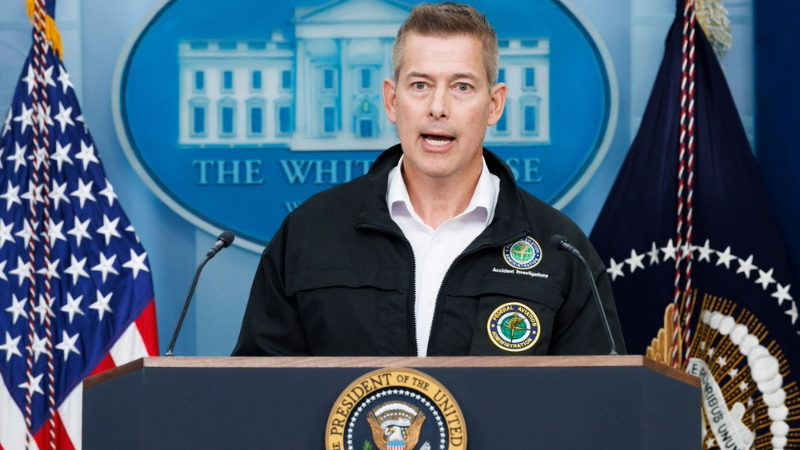
The Federal Aviation Administration (FAA) is out of money to execute the second phase of its modernization plan, but Transportation Secretary Sean Duffy said Thursday morning that he believes Congress will appropriate more funds to keep the effort going.
Speaking at the Air Traffic Control Association’s Aviation Innovation Summit in Arlington, Va., Duffy said that the agency needs more funding to meet its goals of improving national airspace safety and reducing airport delays and cancellations.
Congress gave the FAA a down payment of $12.5 billion under the One Big Beautiful Bill last summer to modernize its air traffic control (ATC) systems. So far, several contracts have been awarded to companies that will serve as the FAA’s prime integrator and oversee radar systems.
On Thursday, the Department of Transportation (DOT) also announced that it is replacing paper strips used by air traffic controllers with electronic flight strips. The strips are used to help manage flight operations.
Duffy noted that while those upgrades make national airspace more resilient, “it doesn’t change the experience, because we’re not righting efficiency with telecom or with radar.”
The next step in the FAA’s modernization efforts will make that shift toward improving efficiency by evaluating software and a common automation platform that will support general aviation and newer innovations such as drone technologies, Duffy said.
“A couple of problems here. One, we don’t have the money for it,” he said. “We do have money that we’re kind of pulling out of the FAA couch cushions that we’re using to work on this. I do think the Congress is gonna give us money for this, but that’s what’s important to change the experience.”
Duffy said that President Donald Trump signed off on an FAA modernization plan totaling more than $31 billion. Duffy noted that lawmakers were hesitant to fully appropriate those funds, however.
He explained that “there’s not a lot of trust with the FAA and DOT because they made promises, they got money, and they didn’t deliver” in previous appropriations.
While Congress did give the FAA the $12.5 billion to modernize, Duffy said that those funds came with specifics and were not as free to spend as the FAA had wanted.
The FAA also received $22.2 billion that the White House requested in its fiscal year 2026 budget proposal – though the FAA had previously noted that much of that will go toward maintenance of aged legacy systems.
In December, FAA Administrator Bryan Bedford told Congress that the FAA needs $20 billion more to go from analog to digital infrastructure and move into the cloud.
Bedford also told lawmakers that the ATC modernization timeline had been compressed to two and a half years – with a complete overhaul slated by late 2028 instead of 2038.
“We are hell bent on reaching our goal; we’re well in our way, we’re hitting our marks thus far,” Duffy said Thursday.