
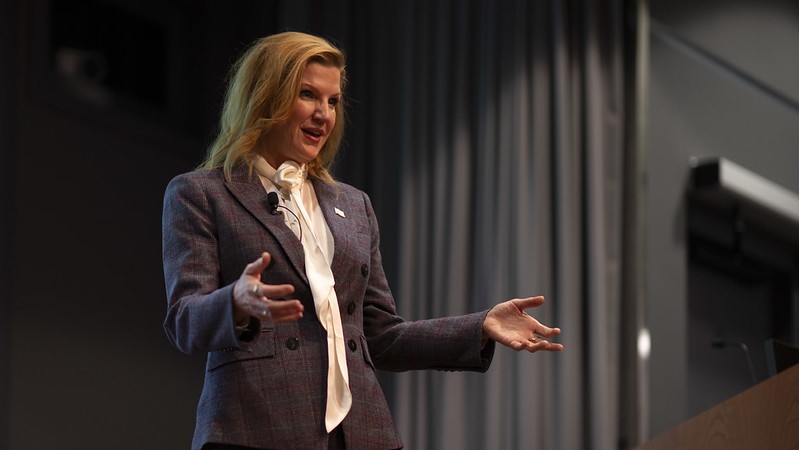
To gain a “decisive warfighting advantage,” Department of Defense (DOD) Chief Information Officer (CIO) Kristen Davies on March 26 introduced a four-pillar plan designed to modernize the Pentagon’s vast technology ecosystem.
Under the Trump administration, the DOD has been rebranded as the Department of War.
During a House Armed Services subcommittee hearing, Davies told lawmakers that “great change is needed” to deliver capabilities that support the readiness, resilience, and lethality of warfighters.
“Our primary goal is to enable data supremacy and decision dominance on the contested battlefields of today and tomorrow,” Davies said.
The plan, she explained, consists of four main priorities: modernizing the network backbone, replacing outdated IT systems, strengthening cybersecurity, and building up the workforce.
“We will revamp how we architect our networks, reshape our engagements across our ecosystem, reform how we design and deliver capabilities, and unleash the power of our data,” Davies said. “These transformative changes will drive efficiency and effectiveness, reduce cyber and operational risk, and ensure we can best leverage commercial technologies and industry best practices.”
Modernize the DOD’s network backbone
First, the Pentagon plans to modernize its network backbone, including cables, satellites, and 5G systems. Davies said 5G capabilities are already deployed at most U.S. military installations.
She described a vast infrastructure that stretches from undersea cables to terrestrial fiber and advanced satellite systems, connecting operations from the “home front to the tactical edge.” The network supports operational technology and Internet of Things devices critical to military missions.
The strategy calls for continued expansion, modernization, and hardening of networks, along with greater use of commercial cloud providers to improve resiliency. Davies said the department is also pursuing data center consolidation and building high-availability, low-latency architectures to support artificial intelligence and next-generation capabilities.
Replace legacy IT systems
Second, the department will replace outdated IT systems.
“Legacy IT does pose quite a significant problem,” Davies said, noting that many older systems are not regularly updated and are harder to secure.
The plan includes shifting from slower, legacy software development to more agile delivery aligned with industry practices. Officials aim to standardize data architectures, accelerate software and software-as-a-service delivery, and improve interoperability across systems.
Davies said the department will modernize or retire legacy applications while addressing inefficiencies in defense business systems.
She also highlighted the deployment of the department’s Mission Partner Environment to “fundamentally change [the] paradigm” of data sharing with allies for faster and collaboration.
Strengthen cybersecurity
Third, the DOD will strengthen cybersecurity by moving away from what Davies called “checklist-driven compliance” to a risk-based model.
The approach includes automation, continuous monitoring, and expanded use of zero trust principles. Davies said the department is working to improve threat detection and response while standardizing policies across its systems.
She warned that cyber risks extend beyond Pentagon networks, including contractors and supply chains, and said the department must take a more holistic view of security across the defense industrial base.
Building up the workforce
Fourth, the Pentagon will address workforce development, with a focus on expanding recruitment and training for cyber professionals.
Davies emphasized that personnel remain central to the department’s technological transformation.
“People are our decisive edge in the contested battlefields of today and tomorrow,” she said. “America’s most precious asset is our people, and as CIO I am doubling down on our approach to skills, training, and readiness.”