The U.S. Army on Oct. 13 expanded international participation in its unmanned aircraft systems (UAS) marketplace to 29 nations, with eight additional countries signing statements of intent to join the procurement platform.
The expansion, announced during the 2026 Association of the United States Army (AUSA) Annual Meeting and Exposition in Washington, D.C., comes as the Army works to accelerate allied access to approved drone and counter-drone systems through streamlined acquisition processes.
The Army’s UAS and Counter-UAS Marketplaces are digital procurement platforms that let military units buy preapproved, standardized systems through existing contracts. The Army’s Joint Interagency Task Force 401 manages both marketplaces, which have processed $800 million in transactions since the initiative launched.
“With today’s signing, the marketplace is now truly a global effort,” said Brent Ingraham, assistant secretary of the Army for acquisition, logistics and technology. “It’s not a concept or a pilot program or some distant future. It is live.”
Representatives from Albania, Canada, Croatia, Egypt, Japan, Kuwait, Morocco, and Panama joined U.S. defense officials at the Oct. 13 ceremony to sign statements of intent to participate in the UAS Marketplace.
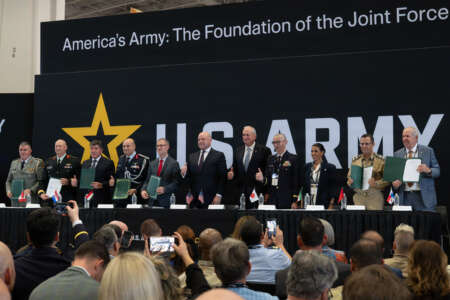 Acting Secretary of the Army Adam R. Telle, Brent Ingraham, Assistant Secretary of the Army for Acquisition, Logistics and Technology, and international allies and partners pose for a photo after signing a UAS and Counter-UAS Statement of Intent during the 2026 AUSA Annual Meeting and Exposition in Washington, D.C., Oct. 13, 2026. (U.S. Army photo by Laura Buchta).
The signing followed a similar ceremony in Paris over the summer, when Denmark, France, Italy, Lithuania, the Netherlands, Norway, Poland, Sweden, and the United Kingdom joined the marketplaces.
The expansion also reflects the Army’s push for greater interoperability among allied forces.
Acting Army Secretary Adam Telle, who attended the ceremony, said the Army’s emphasis on open architecture should extend beyond the technical design of individual systems to include cooperation and interoperability among international partners.
“We need to be thinking about open architecture at the strategic level, and that means open architecture with our partners, sharing in tactics, techniques, and procedures, and sharing in common equipment,” Telle said.
Before accessing the marketplaces, international partners must complete required approvals to comply with U.S. foreign military sales (FMS) and exportability requirements.
Through a procurement pathway known as the “FMS Fast Lane,” participating nations can order preapproved, standard-configuration drone and counter-drone systems through existing contracts.
According to the Army, addressing exportability requirements in advance – including technology transfer approvals, marketing licenses, and foreign disclosure clearances – has reduced traditional FMS case development timelines from months to days.
The streamlined process is intended to accelerate partner access to approved systems while supporting greater interoperability among allied militaries.
“When we buy together, we solidify our existing partnerships and build an unbreakable, interoperable shield,” Ingraham said.